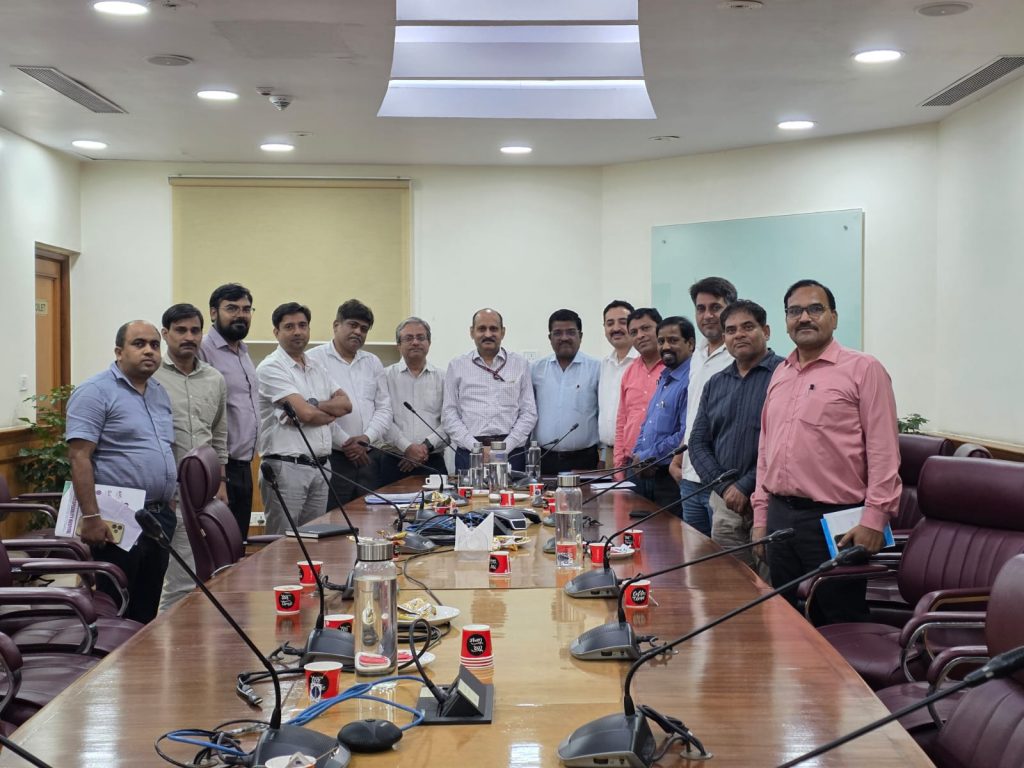
The case seeking replacement of the SG JAG scale from E6 to E7 for officers recruited, absorbed, or promoted in Group ‘B’ services, i.e., those joining the executive cadre as JTO/JAO/Equivalent, was listed before the Hon’ble CAT on 30th July 2026.
Click here for complete detail
Surprisingly, SNEA opposed the impleadment application filed by AIGETOA, for reasons best known to them.
Ordinarily, an impleadment application is opposed by the respondents (BSNL/DoT in this case), while applicants generally welcome the addition of parties having the same cause, as it strengthens the case. SNEA’s decision to oppose AIGETOA’s intervention is, therefore, both surprising and unfortunate.
The Truth Behind the “Delay” Allegation
On its website, SNEA has claimed that it opposed AIGETOA’s Miscellaneous Application (MA) because AIGETOA was allegedly attempting to delay the hearing of the case, which was filed by SNEA in 2022.
This claim does not stand the test of facts.
Despite the case being more than four years old, not even a single effective hearing has taken place. We are sharing snapshots of the court proceedings and hearing history below.
A review of the case history clearly shows that:
- No substantive hearing has taken place.
- No pleadings have been argued.
- The matter has witnessed only repeated adjournments.
The court orders are self-explanatory.
Even more revealing is the fact that, on average, only about two hearings per year took place until April 2026. However, after AIGETOA filed its impleadment application, three hearings have taken place within just three months.
If SNEA was genuinely concerned about avoiding delay, one obvious question arises:
1] Why did SNEA never file an Early Hearing Application before the Hon’ble Bench?
2] Why were no efforts made over the last four years to seek shorter dates or expedite the matter?
The facts speak for themselves.
A Bigger Question That SNEA Must Answer
During the recent membership change window, SNEA alleged that AIGETOA was trying to derail the Standard Pay Scale issue by linking it with the replacement of the SG JAG scale from E6 to E7.
We would like GS SNEA to answer one simple and straightforward question.
What will happen to the Fifth TBP of JTOs/JAOs once the entry-level scale is upgraded from E1A/E1 to E2?
Let us consider a simple example.
If a JTO/JAO is recruited or promoted in E1A/E1, and the entry-level scale is upgraded to E2, then, without replacing the SG JAG scale with E7, only four TBP upgradations will remain available:
E2 → E3 → E4 → E5 → E6
However, if the SG JAG scale is replaced from E6 to E7, the original five TBP upgradations remain intact:
E2 → E3 → E4 → E5 → E6 → E7
This is precisely why replacement of the SG JAG scale is essential.
Setting the Record Straight on the “Cascading” Myth
SNEA has also attempted to create the misconception that:
- AIGETOA is demanding “cascading” by seeking replacement of the SG JAG scale from E6 to E7; and
- Executives already in higher scales would receive a sixth TBP.
Both claims are factually incorrect.
Every executive in BSNL knows that a promotion or financial upgradation requires pay fixation with at least one increment.
Merely replacing E6 with E7 does not result in:
- an additional promotion,
- an additional TBP, or
- even a single rupee increase in actual salary.
It merely changes the pay scale designation while preserving the existing pay.
For executives already in E6, the structure would simply become:
Existing: E1A → E2A → E3 → E4 → E5 → E6
After Replacement: E1A → E2A → E3 → E4 → E5 → E7
Since their existing basic pay would already be above the minimum of E7, there would be absolutely no increase in actual basic pay.
Therefore, calling this a “sixth TBP” reflects either a complete misunderstanding of the pay structure or a deliberate attempt to mislead executives.
This Is Not Cascading
“Cascading” means the replacement of all pay scales across the hierarchy.
That is not what AIGETOA has proposed.
AIGETOA’s proposal is limited to:
- Replacement of the initial entry-level scales as part of the Standard Pay Scale correction.
- Replacement of the SG JAG scale from E6 to E7 so that the existing five TBP structure remains intact.
Executives in the intermediate grades continue in their existing scales.
There is no across-the-board replacement of all grades and no increase in actual basic pay.
Therefore, branding this proposal as “cascading” is factually incorrect.
Why This Court Case Is So Important
If the SG JAG scale is not replaced with E7 after implementation of the Standard Pay Scale, executives recruited or promoted as JTOs/JAOs after 01.01.2007 will suffer serious long-term consequences.
They will:
- Lose one financial upgradation, with only four TBPs available up to E6.
- Face prolonged stagnation in the E6 grade for nearly five to six years in future.
Therefore, replacement of the SG JAG scale from E6 to E7 is not merely desirable. It is essential to:
- Preserve the existing five TBP structure.
- Prevent future stagnation.
- Protect the career progression of thousands of executives.
Why AIGETOA Intervened
This important court case remained virtually unattended for nearly four years.
Despite repeated expectations that SNEA would actively pursue the matter, there was little visible progress.
Only after waiting for almost four years and observing that the case was not being pursued with the urgency it deserved did AIGETOA decide to file an impleadment application so that the matter could be pursued more effectively.
The subsequent increase in the frequency of hearings speaks for itself.
Final Say by AIGETOA :
The malicious propaganda being spread by SNEA and its GS appears to be nothing more than an attempt to divert attention from their own failure to pursue this critical case effectively.
We request every executive to examine the facts independently.
The official case details are available at the following links:
• https://cis.cgat.gov.in/catlive/Misdetailreport123.php?no=MTEwNzIwMDM5MTYyMDIyL2RlbGhp
• https://cis.cgat.gov.in/catlive/additional_mis.php?diary_no=MTEwNzIwMDM5MTYyMDIyL2RlbGhpL1A=
We have also attached screenshots of the court orders, which clearly narrate the true history of the case and its pursuance.